6 November 2026 · By Yvette Lamb
Say what you pay: EA job ads and the UK's new salary law
Just over half of the EA job ads on EAHQ show a salary, and in the UK it's fewer than half. That could soon change: on 5 November 2026, the UK government said it will make it a legal requirement to put pay in job adverts (source: BBC News).
Prime Minister Andy Burnham is also urging employers to start now rather than wait for the law. The Cabinet Office says 94% of people who responded to its summer consultation backed greater pay transparency. No start date, penalties or detail on salary ranges have been published yet. Legislation is promised "as soon as possible" (source: BBC News).
For EAs, this matters every time you weigh up whether a role is worth applying for. So we looked at every EA role listed on EAHQ since June, and compared the UK with the US, Canada and Australia, where the rules are very different.
What EAHQ's data shows
Of 712 EA and admin roles listed on EAHQ between June and early November 2026, 57% included a salary. Most of the rest either:
- 9% offered only a vague line such as "competitive" or "DOE"
- 30% gave no pay information at all
The gap between countries is wide, and it follows the law closely.
| Country | EA ads with a salary | Law requiring salary in job ads? |
|---|---|---|
| United States | 74% | In around 15 states and DC |
| Canada | 66% | In 3 provinces (BC, Ontario, PEI) |
| United Kingdom | 49% | Not yet; promised |
| Australia | 36% | No |
The UK figure is in line with the wider market. Jobs site Adzuna found 51% of all UK adverts showed a salary in September, a share it says has been falling (source: BBC News). CIPD research found only 18% of employers always publish a specific salary, though 41% always include a range (source: Newsy Today).
Seniority made little difference. Leadership roles (67%) and Experienced roles (64%) were slightly more likely to show pay than Developing roles (55%), but no level kept pay hidden as standard.
In the UK, the best-paid roles are the most likely to hide pay
In the UK, the roles that pay the most are the ones least likely to tell you what they pay. Only 42% of UK ads with an Executive Assistant title showed a salary, against 63% of PA roles. EA titles were also the most likely to fall back on "competitive" or "DOE" (13%).
The 2026 EA Salary Survey shows why that matters: UK respondents with an Executive Assistant title earn a median of £52,000, against £39,000 for those with a PA title (source: EA Salary Survey). London follows the same pattern. Ads there were slightly less likely to show pay than elsewhere, even though London is where pay is highest.
| UK group | Ads showing a salary | Median base salary (2026 EA Salary Survey) |
|---|---|---|
| Executive Assistant titles | 42% | £52,000 |
| PA titles | 63% | £39,000 |
| London | 45% | £57,000 |
| Rest of the UK | 53% | £42,000 |
London EA roles were the least open of all, with just 39% showing a salary. Smaller samples suggest part-time and temporary roles are much more open about pay than full-time, permanent ones.
Where there's a law, the salary appears
In US states with pay-transparency laws, 92% of EA roles on EAHQ showed a salary. In states without one, it was 28%.
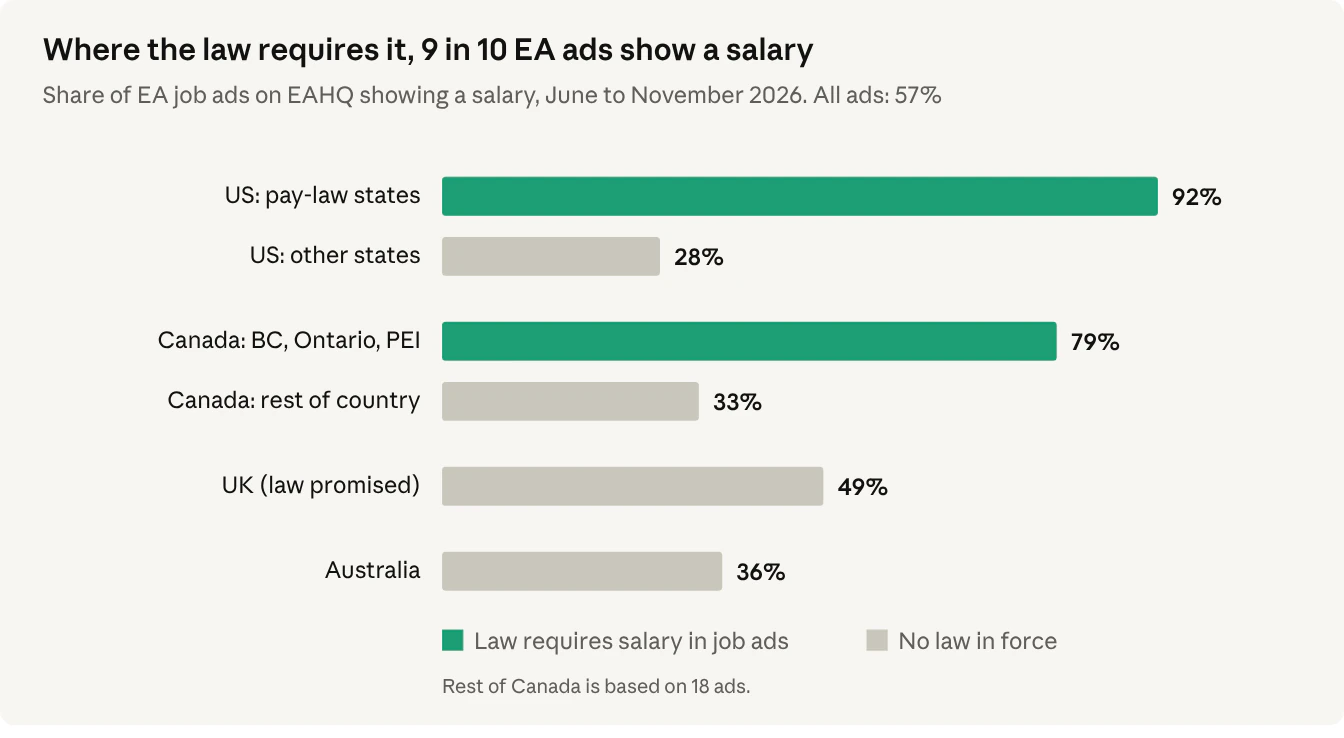 Source: EAHQ listings data, 712 EA roles, June to November 2026
The US has no federal rule. Instead, around 15 jurisdictions require a pay range in the advert itself. Colorado was first in 2021, and California, New York, Washington, Illinois and Massachusetts followed. Virginia, Maine and Connecticut joined in 2026. Across the wider US market, postings in established-law states show pay 73% of the time, against 44% where there's no law (source: JobsPipe).
Canada tells the same story. In British Columbia, Ontario and Prince Edward Island, which all require pay in public job postings (source: Payworks), 79% of EA roles on EAHQ showed a salary. Elsewhere in Canada it was 33%, although only from 18 roles.
Ontario's law, in force since January 2026, applies to employers with 25 or more staff. It also caps a posted range at $50,000 wide unless the job pays more than $200,000 (source: WealthNorth). Indeed found the share of Ontario postings with pay jumped from 49% to 71% after the law came in, while postings outside BC and Ontario stayed flat at around 41% (source: HR Reporter).
Australia: no law, least disclosure
Australia had the lowest rate on EAHQ: just 36% of EA roles showed a salary, and 45% gave no pay information at all.
Australian employers aren't required to put a salary in a job ad (source: Staffing Industry Analysts). Since January 2023, the law has only stopped ads from offering pay below the legal minimum, and banned pay secrecy clauses in employment contracts (source: ACA). A study of SEEK listings found big differences by who was hiring: 46% of recruiter-posted roles included salary, against just 13% from large corporate employers (source: SBS News).
A salary isn't always a useful salary
Where a law requires a range, ranges tend to be wide. On EAHQ, 87% of listed salaries were ranges, and the typical US range was more than twice as wide, proportionally, as the UK's.
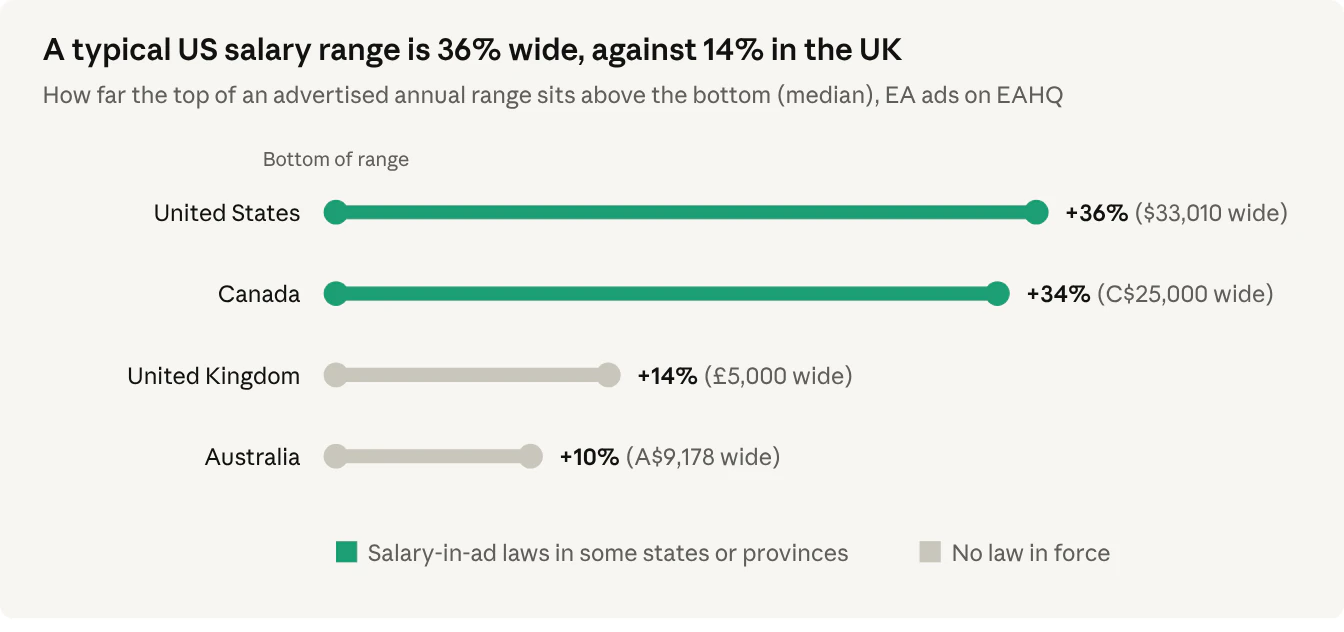 Source: EAHQ listings data, 307 annual salary ranges, June to November 2026
A $33,000 spread tells a candidate far less than a £5,000 one. Ontario's cap on range width exists for exactly this reason. The UK is also the market most likely to give a single figure: 39 of the 134 UK salaries on EAHQ were one number rather than a range.
The UK government hasn't yet said whether its law will allow ranges, or how wide they can be. That detail will decide how much the law actually helps.
Do advertised salaries match what EAs earn?
In the UK, the typical salary advertised on EAHQ is £37,000. That's almost a quarter below the £48,500 median across all UK respondents to the 2026 EA Salary Survey (source: EA Salary Survey).
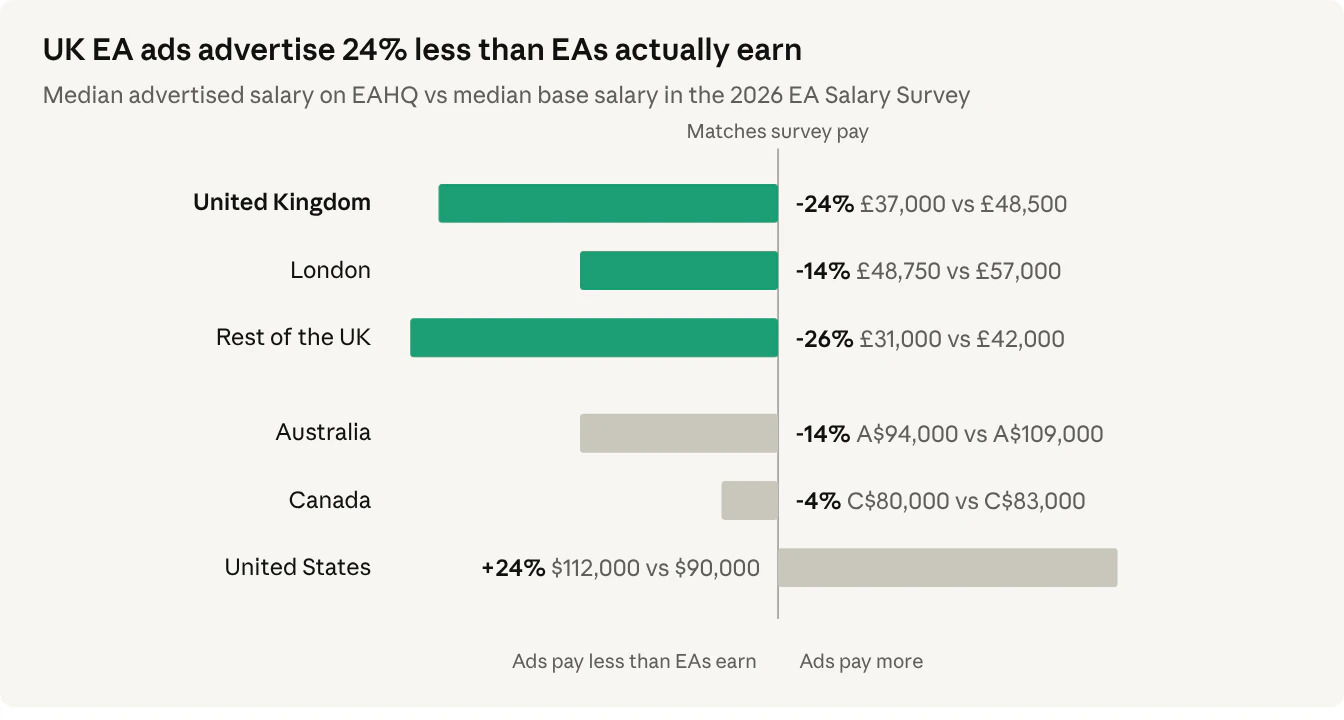 Source: EAHQ listings data (annual salaries, June to November 2026) and 2026 EA Salary Survey base salaries
Part of the gap is down to which roles show pay. UK ads with a salary lean towards entry-level roles, and the higher-paid EA and London roles are the ones keeping pay quiet. So candidates comparing advertised pay are often comparing against the bottom of the market. The US runs the other way: ads there lean towards California and New York, where salaries are high and the law requires them to be shown.
What this means now
For EAs. Pay matters when you're deciding where to apply. It's early days, but most people who've set up an EAHQ job alert so far have added a minimum salary. Until the law arrives, here's what you can do:
- When an ad says "competitive" or "DOE", ask for the range before you spend time on an application. You're entitled to ask, and the answer tells you something about the employer.
- In the UK, employers can still ask what you earn now, but you don't have to answer (source: Newsy Today). Talking about the salary you're looking for, rather than your current one, keeps the conversation on the role.
- Benchmark before you negotiate. The EA Salary Survey covers EA pay by level and location in the UK, US, Australia and Canada.
For EAs who aren't looking to move. This matters even if you're happy where you are. Once employers advertise pay, you'll be able to see what your own company offers new EAs, and what other employers pay for the same role. If the advertised range for a new hire at your level starts above what you earn, that's a fair starting point for your next pay review.
The UK may go further. The equality watchdog has said employees should be able to find out what colleagues earn, and that employers should have to answer questions about colleagues' pay. That isn't law yet (source: BBC News). In Australia, employees have had a legal right to share their pay since January 2023 (source: Public Accountant). To make the most of it now:
- Keep an eye on your employer's ads for roles like yours, and on competitors' ads too.
- Check your pay against the EA Salary Survey for your title, level and location once a year, not only when you're job hunting.
- Go into your review with evidence: advertised ranges and survey figures carry more weight than a feeling that you're underpaid.
For employers and recruiters. The government is asking you to start now, and the evidence from North America suggests the rule will come. Putting a realistic, reasonably narrow range in your EAHQ listing now means you're ready when it does. Recruiters are already ahead: 94% of recruiter roles on EAHQ list a salary.
Weekly digest
New EA roles in your inbox
A curated selection of the best EA, ops-adjacent, and Chief of Staff roles — sent weekly, no spam.
Weekly digest
New EA roles in your inbox
Curated roles every week — no noise, no spam. Just the best EA, ops, and Chief of Staff opportunities worldwide.